A Strategic view of what India Needs, What we can Cut , how how it influences the Exchange Rate.
In light of the recent address by Prime Minister Modi on May 10, 2026, which emphasized national resilience amidst the global energy crisis (U.S.-Iran war), it is crucial to understand how our consumption habits directly dictate the strength of the Indian Rupee.
1. Major Imports of India (FY 2025-26)
India’s total merchandise imports for the last fiscal year reached approximately US$ 775 Billion, a significant increase from previous years $721 Billion.
2. The Economic Impact: The Rupee Connection
The Rupee is currently under pressure, trading near the ₹94–95/$1 range. This depreciation is not just a “market number” it is a cycle fueled by our import bill:
a. The Dollar Demand: Since international trade is conducted in USD, every barrel of oil or gram of gold we buy requires us to sell Rupees and buy Dollars. High demand for Dollars makes them “expensive,” causing the Rupee to weaken.
b. Imported Inflation: As the Rupee falls, anything we must import (like oil) becomes more expensive in local currency. This trickles down to transport costs, food prices, and electricity, hurting the common man’s pocket
c. Trade Deficit: Our merchandise trade deficit reached roughly $333 Billion in FY 2025-26. A wider gap signals to global investors that the economy is “leaking” wealth, further discouraging investment and weakening the currency.
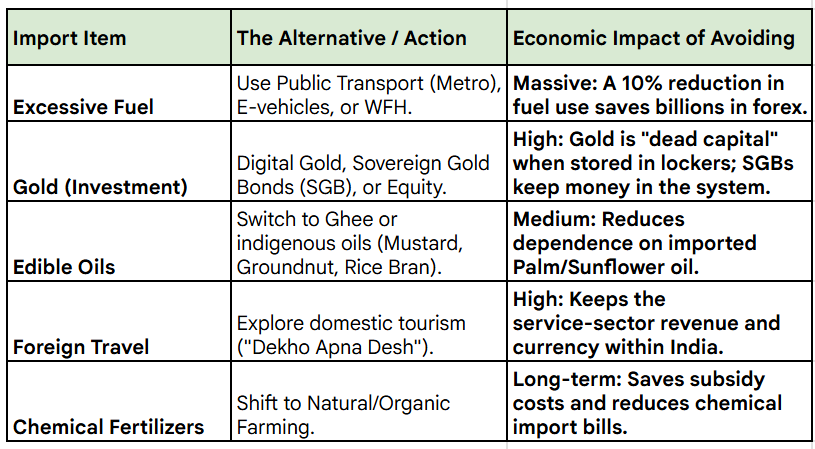
3. What to Avoid: Optimizable Imports (The “Mindset” List)
These are areas where individual choice can change the national economy.
These are areas where individual choice can change the national economy.
4. Perspective: Changing the Mindset
The Prime Minister’s call is a shift from Global Consumption to Local Circularity.
- Patriotism through Consumption: If every household reduces oil consumption by a small fraction or postpones a gold purchase, the cumulative drop in dollar demand can stabilize the Rupee.
- From “Foreign” to “Indigenous”: The goal is to move away from the “imported is better” status symbol. Using home-grown brands isn’t just about pride; it’s about preventing the “flight of capital.”
- The Multiplier Effect: By avoiding $1 Billion in non-essential imports, we don’t just save money we create a “cushion” for the RBI to defend the Rupee, keeping interest rates stable and loans cheaper for everyone.
Bottom Line: A stronger Rupee starts at the billing counter. Choosing “Swadeshi” today is the most direct way a citizen can fight global inflation and currency depreciation.